
The 6-Year-Old Architect: Our Weekly Scratch Routine
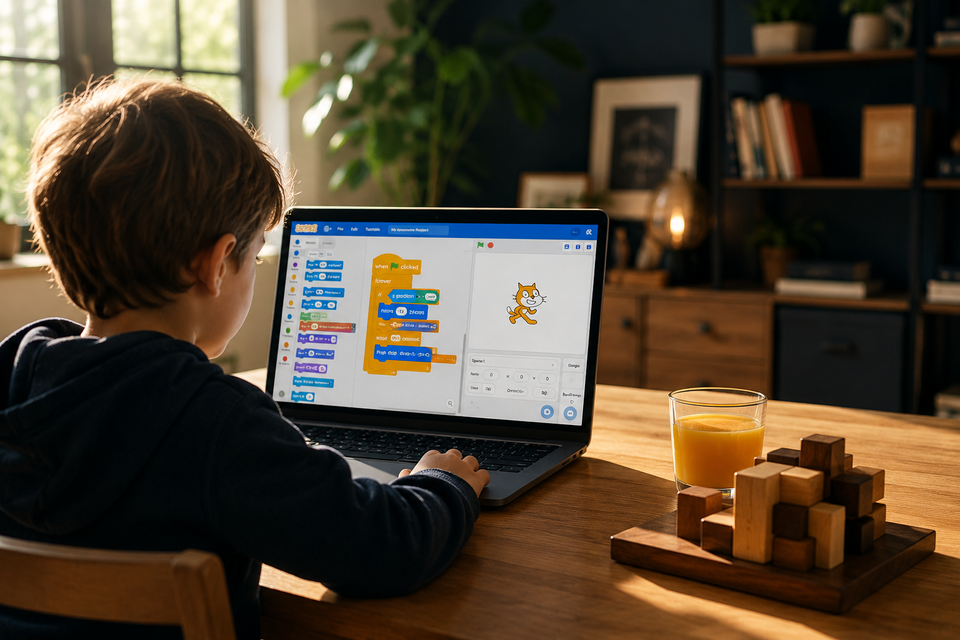
1. The "Golden Ratio" of Time (Duration & Frequency)
For a 6-year-old, focus is a finite resource. As a Senior Dev, I treat our sessions like a "Sprint."
- The Routine: We do ~30 minutes, 3 times a week. * The Logic: At age 6, cognitive load is high. Short, frequent "bursts" are better for long-term retention than one long 90-minute session. It prevents "Digital Burnout" and keeps them coming back with excitement.
- The "Stealth" Benefit: This schedule fits perfectly into the busy lives of families. It feels manageable, not like another "heavy" chore.
While we do short 'sprints' during the week to keep the logic fresh, the weekends are for Deep Work. We set aside 1 hour each day. This gives my son enough time to move past the 'setup' phase and actually get lost in the problem-solving.
- Saturday (The Build): Focus on the core mechanics. "Does the character move? Does the score work?"
- Sunday (The Creative Layer): Focus on the "UX" (User Experience). "What sounds should we add? Can we make the background change color?"
I’m not sitting over his shoulder for the full 60 minutes. I act as the 'Senior Consultant.' I go grab a coffee, let him struggle for 15 minutes, and then I 'swing by' for a 5-minute Code Review. This builds his independence while ensuring he doesn't hit a wall he can't climb.
2. Structured Learning vs. "The Sandbox" (What he does)
I divide our sessions into two distinct phases. This is the "Secret Sauce" of my 10-Module system.
- Phase A: The Mission (10 mins): We follow one specific goal from a module (e.g., "Make the cat move when the spacebar is pressed"). This is Directed Learning.
- Phase B: The Sandbox (15–20 mins): I step back. I tell him, "The computer is yours now. Make it weird." He might add 50 sounds or change the cat into a dinosaur.
- Why this matters: Phase A builds Competence, but Phase B builds Ownership. If a child only follows instructions, they are a "User." If they explore, they are an "Explorer."
3. The Importance of "Tinkering" (The Why)
Parents often ask: "Why let them just play around? Isn't that wasting time?"
- The Senior Dev Answer: In the professional world, we call this R&D (Research & Development). * The Benefit: When a 6-year-old "explores," they are accidentally discovering Edge Cases. They learn that if they set the speed to 1000, the character disappears. That is a lesson in Boundaries and Variables that no textbook can teach as effectively as a "mistake" in the sandbox.
- Neurological Growth: This open-ended play strengthens Synaptic Plasticity. They are learning that they can change the "Rules of the World" through logic.
4. How it helps him "Even Further" (The Long Game)
By doing this routine, my 6-year-old is developing three "Superpowers" that will help him in school and life:
- Algorithmic Thinking: He now explains things in steps. "First I put on my shoes, then I tie the laces."
- Frustration Tolerance: When his Scratch code doesn't work, he doesn't cry. He says, "Wait, there's a bug," and starts looking for it. That resilience is priceless.
- Language Acquisition: Scratch is a language. Learning it at 6 is like learning a second spoken language—it becomes "native" to his brain.
Member discussion